Cor Vitreum
Black Friday price€150Regular price€300
a glass heart full of water, a carp leaping out; the extra heartbeat.

A dragon with its skin taken off, rib cage at the bottom, spine coiling up to a horned head with open jaws. Every bone and muscle a nursing student drills in A&P, wrapped around one animal. It goes on the wall above the desk where they'll study for the NCLEX.
Shipping to Europe €45 · usually 2 to 3 weeks, no later than 28 days after payment
For Christmas in the UK: order by Thursday 26 November, delivered by 24 December at the latest.
Fine art print on canvas, 3.8 cm (1.5 in) wooden stretcher, signed and numbered by hand
Card payment via Stripe; shipping cost and delivery countries shown at checkout, before you pay
14 days to change your mind after delivery (return shipping at your expense, refund within 14 days of receiving the return)
2-year legal guarantee of conformity
William San
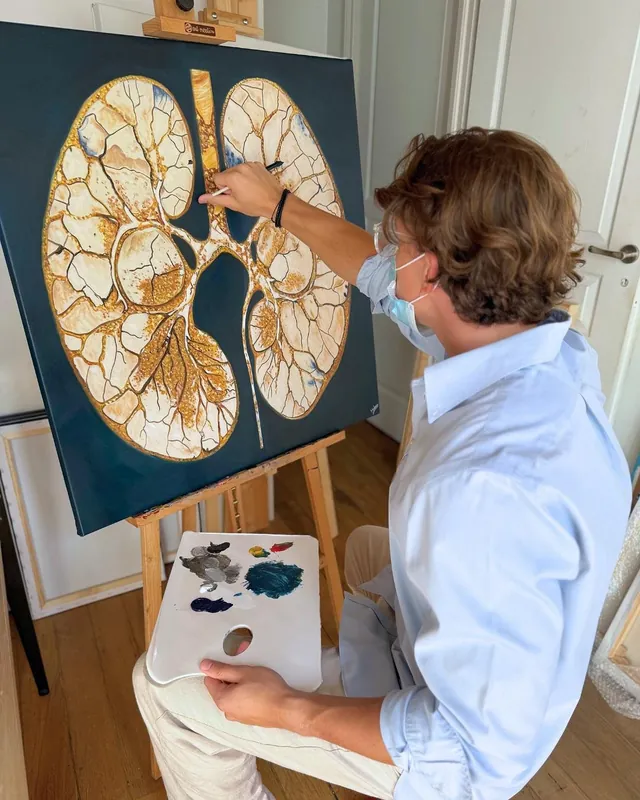
William San paints the Medsan canvases in Orléans, France, at the Atelier Joconde, his family's studio.
He signs and numbers every print by hand: 20 per size, never more.
Read the Medsan Story
The ground is dark brown, scrubbed like a burnt plank. The dragon doesn't fit in the frame. Its chest is cut off by the bottom edge, so the first thing you see is a rib cage up close. The ivory ribs curve in toward a central breastbone, and thin red vessels run over them like threads.
The shoulder at the lower right is a heavy block of red meat, its strands combed in one direction like a rope. Above the chest the vertebrae stack up in pale blocks, each with a short spike on its back edge. A long strap of muscle climbs beside them and wraps around to the back of the skull.
The snout points left and a little down. The nostrils flare, the lip pulls back from small sharp teeth, and a tuft of bone hangs off the chin like a paintbrush. Under a heavy brow the eye is a pale amber slit. Two branched horns rise from the crown, chipped at the tips. From the upper lip, two red filaments curl away and drift down past the jaw, about as thin as IV tubing.
William San calls this canvas his silent manifesto. For him the body and myth explain each other: an anatomy chart can be read as a legend, and a legend as an anatomy chart.
The painting looks back to Japan in the 1700s. Doctors there started sketching what actually sits under the skin, and before that, people pictured dragons in there. The dragon remembers those years, when people looked for their insides in bestiaries and the real thing turned out stranger than the monsters.
Each of his earlier stories, he says, has its place inside this animal, the one he chose as the emblem of his work.
Anatomy doesn't stay behind in first semester. The 2026 NCLEX-RN Test Plan, in force since April 2026, expects nurses to draw on the biological sciences, which it spells out as anatomy, physiology, biology and microbiology.
One subcategory, Physiological Adaptation, accounts for 11 to 17% of the items. Its list of activity statements includes "Identify pathophysiology related to an acute or chronic condition," next to chest tube drainage, ventilators, telemetry and arterial lines.
The exam adapts to the candidate. Every RN candidate answers at least 85 items and at most 150, within a five-hour limit that includes all breaks. Fifteen of those items are unscored pretest items, and nobody taking the test can tell which ones.
Hang it where they study and use it as a quiz. Name the bones first, then the vessels, then what happens to a body when one of them fails.
Source: National Council of State Boards of Nursing (NCSBN), "2026 NCLEX-RN Test Plan", effective April 2026, nclex.com (PDF), consulted in November 2026.
The lists online all suggest the same things. Compression socks, a badge reel, a good stethoscope, a mug with a coffee joke. All useful, and all of it ends up at the bottom of a clinical bag by second semester. This gift is for the nights before clinicals, not the clinicals themselves.
It usually comes from a parent, a partner, or the clinical group that shared the same 6 a.m. report. Good moments are the end of the first semester, passing A&P, the white coat ceremony, or the week the NCLEX date is booked. For the end of the program, see our "pinning ceremony gifts" and "nursing graduation gifts".
If the student already leans toward a unit, a single organ may say more. Cor Vitreum (the heart) suits someone headed for telemetry or cardiac step-down, and Corallium (the lungs) suits a future respiratory or pulmonary nurse. Both come in 40 × 40 cm.
We don't promise a Christmas date outside Europe. The canvas ships within 15 days at the latest. It usually arrives in 2 weeks in France, 2 to 3 weeks in the rest of Europe and the UK, 3 to 4 weeks elsewhere, and no later than 21, 28 and 35 days after payment respectively. If it misses the 25th, it can still go up for the start of spring semester.
At a distance you notice the creature first. The anatomy shows up when you get close. There's no wound and no surgery, only muscle, bone and vessels, like a lab model.
It's a fine art print on canvas, signed and numbered by hand, 20 copies per size, with a certificate of authenticity.
You have 14 days after delivery to change your mind. Payment is by card through Stripe.
Our page on "gifts for nurses" picks a painting by unit and specialty.
Black Friday price€150Regular price€300
a glass heart full of water, a carp leaping out; the extra heartbeat.
Black Friday price€150Regular price€300
two coral lungs, fish, a column of bubbles; asthma.
Black Friday price€150Regular price€300
a face in profile turning into an anatomical study, camellias; facial palsy.
Black Friday price€250Regular price€400
Shipping to Europe €45 · usually 2 to 3 weeks, no later than 28 days after payment
For Christmas in the UK: order by Thursday 26 November, delivered by 24 December at the latest.
A dragon with its skin taken off, rib cage at the bottom, spine coiling up to a horned head with open jaws. Every bone and muscle a nursing student drills in A&P, wrapped around one animal. It goes on the wall above the desk where they'll study for the NCLEX.
Shipping to Europe €45 · usually 2 to 3 weeks, no later than 28 days after payment
For Christmas in the UK: order by Thursday 26 November, delivered by 24 December at the latest.
Fine art print on canvas, 3.8 cm (1.5 in) wooden stretcher, signed and numbered by hand
Card payment via Stripe; shipping cost and delivery countries shown at checkout, before you pay
14 days to change your mind after delivery (return shipping at your expense, refund within 14 days of receiving the return)
2-year legal guarantee of conformity
William San
William San paints the Medsan canvases in Orléans, France, at the Atelier Joconde, his family's studio.
He signs and numbers every print by hand: 20 per size, never more.
Read the Medsan StoryThe ground is dark brown, scrubbed like a burnt plank. The dragon doesn't fit in the frame. Its chest is cut off by the bottom edge, so the first thing you see is a rib cage up close. The ivory ribs curve in toward a central breastbone, and thin red vessels run over them like threads.
The shoulder at the lower right is a heavy block of red meat, its strands combed in one direction like a rope. Above the chest the vertebrae stack up in pale blocks, each with a short spike on its back edge. A long strap of muscle climbs beside them and wraps around to the back of the skull.
The snout points left and a little down. The nostrils flare, the lip pulls back from small sharp teeth, and a tuft of bone hangs off the chin like a paintbrush. Under a heavy brow the eye is a pale amber slit. Two branched horns rise from the crown, chipped at the tips. From the upper lip, two red filaments curl away and drift down past the jaw, about as thin as IV tubing.
William San calls this canvas his silent manifesto. For him the body and myth explain each other: an anatomy chart can be read as a legend, and a legend as an anatomy chart.
The painting looks back to Japan in the 1700s. Doctors there started sketching what actually sits under the skin, and before that, people pictured dragons in there. The dragon remembers those years, when people looked for their insides in bestiaries and the real thing turned out stranger than the monsters.
Each of his earlier stories, he says, has its place inside this animal, the one he chose as the emblem of his work.
Anatomy doesn't stay behind in first semester. The 2026 NCLEX-RN Test Plan, in force since April 2026, expects nurses to draw on the biological sciences, which it spells out as anatomy, physiology, biology and microbiology.
One subcategory, Physiological Adaptation, accounts for 11 to 17% of the items. Its list of activity statements includes "Identify pathophysiology related to an acute or chronic condition," next to chest tube drainage, ventilators, telemetry and arterial lines.
The exam adapts to the candidate. Every RN candidate answers at least 85 items and at most 150, within a five-hour limit that includes all breaks. Fifteen of those items are unscored pretest items, and nobody taking the test can tell which ones.
Hang it where they study and use it as a quiz. Name the bones first, then the vessels, then what happens to a body when one of them fails.
Source: National Council of State Boards of Nursing (NCSBN), "2026 NCLEX-RN Test Plan", effective April 2026, nclex.com (PDF), consulted in November 2026.
The lists online all suggest the same things. Compression socks, a badge reel, a good stethoscope, a mug with a coffee joke. All useful, and all of it ends up at the bottom of a clinical bag by second semester. This gift is for the nights before clinicals, not the clinicals themselves.
It usually comes from a parent, a partner, or the clinical group that shared the same 6 a.m. report. Good moments are the end of the first semester, passing A&P, the white coat ceremony, or the week the NCLEX date is booked. For the end of the program, see our "pinning ceremony gifts" and "nursing graduation gifts".
If the student already leans toward a unit, a single organ may say more. Cor Vitreum (the heart) suits someone headed for telemetry or cardiac step-down, and Corallium (the lungs) suits a future respiratory or pulmonary nurse. Both come in 40 × 40 cm.
We don't promise a Christmas date outside Europe. The canvas ships within 15 days at the latest. It usually arrives in 2 weeks in France, 2 to 3 weeks in the rest of Europe and the UK, 3 to 4 weeks elsewhere, and no later than 21, 28 and 35 days after payment respectively. If it misses the 25th, it can still go up for the start of spring semester.
At a distance you notice the creature first. The anatomy shows up when you get close. There's no wound and no surgery, only muscle, bone and vessels, like a lab model.
It's a fine art print on canvas, signed and numbered by hand, 20 copies per size, with a certificate of authenticity.
You have 14 days after delivery to change your mind. Payment is by card through Stripe.
Our page on "gifts for nurses" picks a painting by unit and specialty.
Black Friday price€150Regular price€300
a glass heart full of water, a carp leaping out; the extra heartbeat.
Black Friday price€150Regular price€300
two coral lungs, fish, a column of bubbles; asthma.
Black Friday price€150Regular price€300
a face in profile turning into an anatomical study, camellias; facial palsy.
Black Friday price€250Regular price€400
Shipping to Europe €45 · usually 2 to 3 weeks, no later than 28 days after payment
For Christmas in the UK: order by Thursday 26 November, delivered by 24 December at the latest.