Dragonomy (40 × 60)
Black Friday price€250Regular price€400
a flayed dragon, muscles and ribs exposed; the manifesto canvas.

A woman in profile, red camellias in her hair. Her cheek fades away to show the jawbone and teeth, and her neck turns into a column of vertebrae drawn in pen, like a page from a Renaissance anatomy notebook.
Shipping to Europe €45 · usually 2 to 3 weeks, no later than 28 days after payment
For Christmas in the UK: order by Thursday 26 November, delivered by 24 December at the latest.
Fine art print on canvas, 3.8 cm (1.5 in) wooden stretcher, signed and numbered by hand
Card payment via Stripe; shipping cost and delivery countries shown at checkout, before you pay
14 days to change your mind after delivery (return shipping at your expense, refund within 14 days of receiving the return)
2-year legal guarantee of conformity
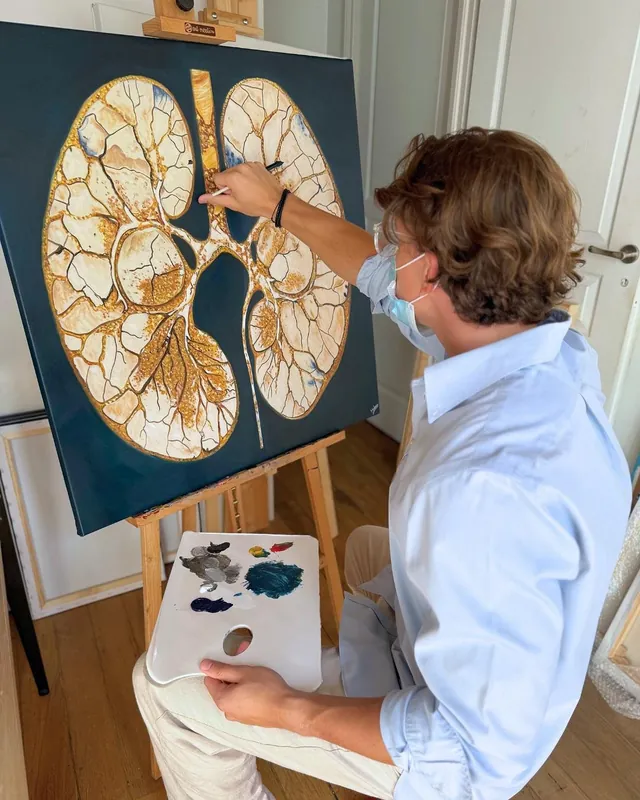
William San
William San paints the Medsan canvases in Orléans, France, at the Atelier Joconde, his family's studio.
He signs and numbers every print by hand: 20 per size, never more.
Read the Medsan Story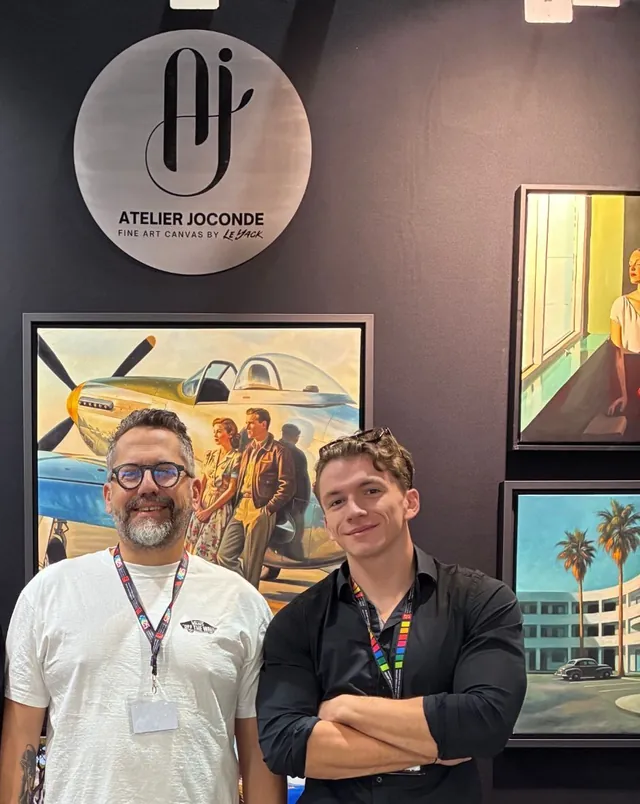
The ground is a yellowed notebook page, covered in handwritten notes, proportion lines and small sketches of fish. In the middle, a young woman in profile: black chignon, white and red kimono, gold pins and camellias in her hair. The top of her face is painted: closed eyelid, red make-up. The bottom is drawn in line: under skin turned transparent you see the jawbone, the teeth, then the cervical vertebrae running down the neck to the shoulder. Three red-and-white koi swim around her, half painted, half sketched.
Looking at one of Leonardo's anatomy sheets, with a face on one side and the mechanism beneath it on the other, William San wanted to paint the moment they separate.
The canvas comes from the account of a forty-one-year-old woman who wakes up with half her face frozen. Facial palsy, overnight. She is told a nerve is inflamed and that it will all come back, probably within a few weeks. Meanwhile she drinks through a straw and, at night, closes her eyelid with her finger.
The Japanese camellia does not shed its petals one by one: the whole flower drops at once. On the canvas, half the face is still the flower; the other half is already the study.
It is a case every student meets on the wards: Bell's palsy. The Danish physician Erik Peitersen followed more than 2,500 facial palsies in Copenhagen over twenty-five years, about 1,700 of them Bell's palsy, to see how they evolve without treatment. In that group, 85% of patients showed the first signs of recovery within three weeks, and about 71% got back a completely normal face. Today, steroids given in the first days improve recovery further (Sullivan et al., 2007).
That is the "it will probably all come back" of the story. The canvas shows what stays still under the face: jawbone, teeth, neck vertebrae, all first-year anatomy. And a sharp student will notice that the painting splits the face top and bottom, while Bell's palsy takes one whole side, forehead included: a forehead that still moves points to a central palsy. The canvas is not a clinical diagram, but it asks the first exam question.
Sources: Peitersen E., "Bell's palsy: the spontaneous course of 2,500 peripheral facial nerve palsies of different etiologies", Acta Oto-Laryngologica, supplement 549, 2002; Sullivan F. M. et al., "Early treatment with prednisolone or acyclovir in Bell's palsy", New England Journal of Medicine, vol. 357, 2007.
The usual presents are a stethoscope, a watch, a clinical exam textbook. They'll be given three stethoscopes and two watches. Nobody will give them a painting.
A good moment: the acceptance letter, or the first day of anatomy. For graduation, Dragonomy is the more formal choice (see below).
The milestones of medical school: the acceptance, the start of anatomy, the white coat ceremony, passing the big exams, choosing a specialty. The painting belongs to no specialty: a face, a jaw and a neck are on everyone's syllabus.
No, they are studio notes in the spirit of Leonardo's notebooks, not a lecture. The drawn anatomy, though, is right: jaw, teeth, cervical vertebrae.
40 centimeters a side (16 in), 3.8 cm (1.5 in) deep, one nail. It survives every move, from med school to residency: no frame, no glass to break.
Black Friday price€250Regular price€400
a flayed dragon, muscles and ribs exposed; the manifesto canvas.
Black Friday price€150Regular price€300
a blue and red porcelain brain, cracked and mended with gold; recovery after a stroke.
Black Friday price€150Regular price€300
a glass heart full of water, a carp leaping out; the extra heartbeat.
Black Friday price€150Regular price€300
two coral lungs, fish, a column of bubbles; asthma.
Black Friday price€150Regular price€300
Shipping to Europe €45 · usually 2 to 3 weeks, no later than 28 days after payment
For Christmas in the UK: order by Thursday 26 November, delivered by 24 December at the latest.
A woman in profile, red camellias in her hair. Her cheek fades away to show the jawbone and teeth, and her neck turns into a column of vertebrae drawn in pen, like a page from a Renaissance anatomy notebook.
Shipping to Europe €45 · usually 2 to 3 weeks, no later than 28 days after payment
For Christmas in the UK: order by Thursday 26 November, delivered by 24 December at the latest.
Fine art print on canvas, 3.8 cm (1.5 in) wooden stretcher, signed and numbered by hand
Card payment via Stripe; shipping cost and delivery countries shown at checkout, before you pay
14 days to change your mind after delivery (return shipping at your expense, refund within 14 days of receiving the return)
2-year legal guarantee of conformity
William San
William San paints the Medsan canvases in Orléans, France, at the Atelier Joconde, his family's studio.
He signs and numbers every print by hand: 20 per size, never more.
Read the Medsan StoryThe ground is a yellowed notebook page, covered in handwritten notes, proportion lines and small sketches of fish. In the middle, a young woman in profile: black chignon, white and red kimono, gold pins and camellias in her hair. The top of her face is painted: closed eyelid, red make-up. The bottom is drawn in line: under skin turned transparent you see the jawbone, the teeth, then the cervical vertebrae running down the neck to the shoulder. Three red-and-white koi swim around her, half painted, half sketched.
Looking at one of Leonardo's anatomy sheets, with a face on one side and the mechanism beneath it on the other, William San wanted to paint the moment they separate.
The canvas comes from the account of a forty-one-year-old woman who wakes up with half her face frozen. Facial palsy, overnight. She is told a nerve is inflamed and that it will all come back, probably within a few weeks. Meanwhile she drinks through a straw and, at night, closes her eyelid with her finger.
The Japanese camellia does not shed its petals one by one: the whole flower drops at once. On the canvas, half the face is still the flower; the other half is already the study.
It is a case every student meets on the wards: Bell's palsy. The Danish physician Erik Peitersen followed more than 2,500 facial palsies in Copenhagen over twenty-five years, about 1,700 of them Bell's palsy, to see how they evolve without treatment. In that group, 85% of patients showed the first signs of recovery within three weeks, and about 71% got back a completely normal face. Today, steroids given in the first days improve recovery further (Sullivan et al., 2007).
That is the "it will probably all come back" of the story. The canvas shows what stays still under the face: jawbone, teeth, neck vertebrae, all first-year anatomy. And a sharp student will notice that the painting splits the face top and bottom, while Bell's palsy takes one whole side, forehead included: a forehead that still moves points to a central palsy. The canvas is not a clinical diagram, but it asks the first exam question.
Sources: Peitersen E., "Bell's palsy: the spontaneous course of 2,500 peripheral facial nerve palsies of different etiologies", Acta Oto-Laryngologica, supplement 549, 2002; Sullivan F. M. et al., "Early treatment with prednisolone or acyclovir in Bell's palsy", New England Journal of Medicine, vol. 357, 2007.
The usual presents are a stethoscope, a watch, a clinical exam textbook. They'll be given three stethoscopes and two watches. Nobody will give them a painting.
A good moment: the acceptance letter, or the first day of anatomy. For graduation, Dragonomy is the more formal choice (see below).
The milestones of medical school: the acceptance, the start of anatomy, the white coat ceremony, passing the big exams, choosing a specialty. The painting belongs to no specialty: a face, a jaw and a neck are on everyone's syllabus.
No, they are studio notes in the spirit of Leonardo's notebooks, not a lecture. The drawn anatomy, though, is right: jaw, teeth, cervical vertebrae.
40 centimeters a side (16 in), 3.8 cm (1.5 in) deep, one nail. It survives every move, from med school to residency: no frame, no glass to break.
Black Friday price€250Regular price€400
a flayed dragon, muscles and ribs exposed; the manifesto canvas.
Black Friday price€150Regular price€300
a blue and red porcelain brain, cracked and mended with gold; recovery after a stroke.
Black Friday price€150Regular price€300
a glass heart full of water, a carp leaping out; the extra heartbeat.
Black Friday price€150Regular price€300
two coral lungs, fish, a column of bubbles; asthma.
Black Friday price€150Regular price€300
Shipping to Europe €45 · usually 2 to 3 weeks, no later than 28 days after payment
For Christmas in the UK: order by Thursday 26 November, delivered by 24 December at the latest.