Aurum Femina
Black Friday price€150Regular price€300
a woman in a purple kimono facing her own skeleton; osteoporosis.

A woman's pelvis set down like a vase, with white orchids growing out of it. For the midwife who brought your baby through it, or the one who finally believed your pain.
Shipping to Europe €45 · usually 2 to 3 weeks, no later than 28 days after payment
For Christmas in the UK: order by Thursday 26 November, delivered by 24 December at the latest.
Fine art print on canvas, 3.8 cm (1.5 in) wooden stretcher, signed and numbered by hand
Card payment via Stripe; shipping cost and delivery countries shown at checkout, before you pay
14 days to change your mind after delivery (return shipping at your expense, refund within 14 days of receiving the return)
2-year legal guarantee of conformity
William San
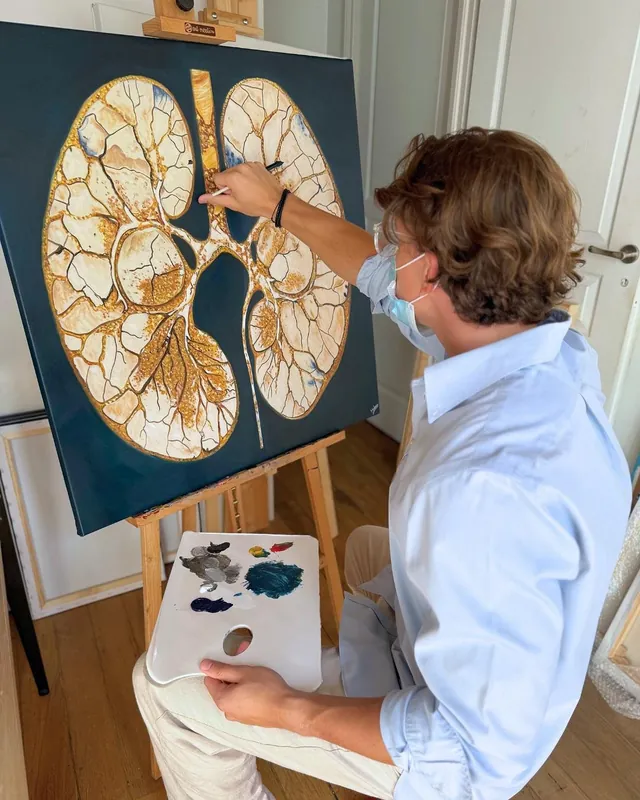
William San paints the Medsan canvases in Orléans, France, at the Atelier Joconde, his family's studio.
He signs and numbers every print by hand: 20 per size, never more.
Read the Medsan Story
On a cream ground, a bony pelvis seen from the front, ivory, picked out with a few gold lines. In its hollow, where you would expect the soil of a pot, a spray of white orchids with blush-pink hearts rises up; the stems start at the sacrum and fan out to the top edge. Everything is pale, pink and white, without a single dark shadow.
The pelvis is the passage every baby she has delivered came through. The story behind the flowers is another one, a story midwives hear too: a twenty-eight-year-old woman whom nobody believed for years. A week ahead, she knew the pain was coming back. She was told it was in her head. The word came later: endometriosis, fragments of tissue similar to the lining of the womb settling where they should not be.
In Chinese painting, and later in Japan, the orchid is one of the "Four Gentlemen": the plant of the scholar who doesn't show off, because it flowers in the shade.
Around one woman in ten of reproductive age has endometriosis, according to the World Health Organization. In the UK, the charity Endometriosis UK puts the average wait for a diagnosis at 9 years and 4 months (March 2026 report, up from 8 years in 2020); in France, where the painter works, the health ministry says 7 years.
The title has a second meaning. Sacra points to the sacrum, the triangular bone at the back of the pelvis, at the foot of the spine. Its Latin name, os sacrum, translates the Greek hieron osteon, the "sacred bone". Its promontory, the front edge of the first sacral vertebra, is the point a midwife's fingers reach for when measuring the diagonal conjugate to check that the inlet of the pelvis leaves room for a baby's head. In a roomy pelvis her fingers can't reach it at all, which is good news.
Sources: World Health Organization, "Endometriosis" fact sheet; Endometriosis UK, "The State of Endometriosis Care", March 2026; info.gouv.fr, "Vivre avec l'endométriose"; Merriam-Webster Medical Dictionary, "sacrum".
Parents thank her when they leave the maternity ward, at the end of antenatal classes, or when she retires after thousands of births. Usually with a card, or chocolates left in the staff room.
The bone is painted like a porcelain vase, and the flowers take over. For a midwife, it is above all a familiar bone.
The painting is about women's pain that was not believed, and flowers that grow anyway. For a birth, the card can say it simply: a pelvis, and life coming out of it.
Yes: enter the hospital's address at checkout, and let the team know so the parcel doesn't sit at reception.
Black Friday price€150Regular price€300
a woman in a purple kimono facing her own skeleton; osteoporosis.
Black Friday price€150Regular price€300
Shipping to Europe €45 · usually 2 to 3 weeks, no later than 28 days after payment
For Christmas in the UK: order by Thursday 26 November, delivered by 24 December at the latest.
A woman's pelvis set down like a vase, with white orchids growing out of it. For the midwife who brought your baby through it, or the one who finally believed your pain.
Shipping to Europe €45 · usually 2 to 3 weeks, no later than 28 days after payment
For Christmas in the UK: order by Thursday 26 November, delivered by 24 December at the latest.
Fine art print on canvas, 3.8 cm (1.5 in) wooden stretcher, signed and numbered by hand
Card payment via Stripe; shipping cost and delivery countries shown at checkout, before you pay
14 days to change your mind after delivery (return shipping at your expense, refund within 14 days of receiving the return)
2-year legal guarantee of conformity
William San
William San paints the Medsan canvases in Orléans, France, at the Atelier Joconde, his family's studio.
He signs and numbers every print by hand: 20 per size, never more.
Read the Medsan StoryOn a cream ground, a bony pelvis seen from the front, ivory, picked out with a few gold lines. In its hollow, where you would expect the soil of a pot, a spray of white orchids with blush-pink hearts rises up; the stems start at the sacrum and fan out to the top edge. Everything is pale, pink and white, without a single dark shadow.
The pelvis is the passage every baby she has delivered came through. The story behind the flowers is another one, a story midwives hear too: a twenty-eight-year-old woman whom nobody believed for years. A week ahead, she knew the pain was coming back. She was told it was in her head. The word came later: endometriosis, fragments of tissue similar to the lining of the womb settling where they should not be.
In Chinese painting, and later in Japan, the orchid is one of the "Four Gentlemen": the plant of the scholar who doesn't show off, because it flowers in the shade.
Around one woman in ten of reproductive age has endometriosis, according to the World Health Organization. In the UK, the charity Endometriosis UK puts the average wait for a diagnosis at 9 years and 4 months (March 2026 report, up from 8 years in 2020); in France, where the painter works, the health ministry says 7 years.
The title has a second meaning. Sacra points to the sacrum, the triangular bone at the back of the pelvis, at the foot of the spine. Its Latin name, os sacrum, translates the Greek hieron osteon, the "sacred bone". Its promontory, the front edge of the first sacral vertebra, is the point a midwife's fingers reach for when measuring the diagonal conjugate to check that the inlet of the pelvis leaves room for a baby's head. In a roomy pelvis her fingers can't reach it at all, which is good news.
Sources: World Health Organization, "Endometriosis" fact sheet; Endometriosis UK, "The State of Endometriosis Care", March 2026; info.gouv.fr, "Vivre avec l'endométriose"; Merriam-Webster Medical Dictionary, "sacrum".
Parents thank her when they leave the maternity ward, at the end of antenatal classes, or when she retires after thousands of births. Usually with a card, or chocolates left in the staff room.
The bone is painted like a porcelain vase, and the flowers take over. For a midwife, it is above all a familiar bone.
The painting is about women's pain that was not believed, and flowers that grow anyway. For a birth, the card can say it simply: a pelvis, and life coming out of it.
Yes: enter the hospital's address at checkout, and let the team know so the parcel doesn't sit at reception.
Black Friday price€150Regular price€300
a woman in a purple kimono facing her own skeleton; osteoporosis.
Black Friday price€150Regular price€300
Shipping to Europe €45 · usually 2 to 3 weeks, no later than 28 days after payment
For Christmas in the UK: order by Thursday 26 November, delivered by 24 December at the latest.