Codex Camellia
facial palsy
Black Friday price€150Regular price€300
a face in profile turning into an anatomical study, camellias; facial palsy.
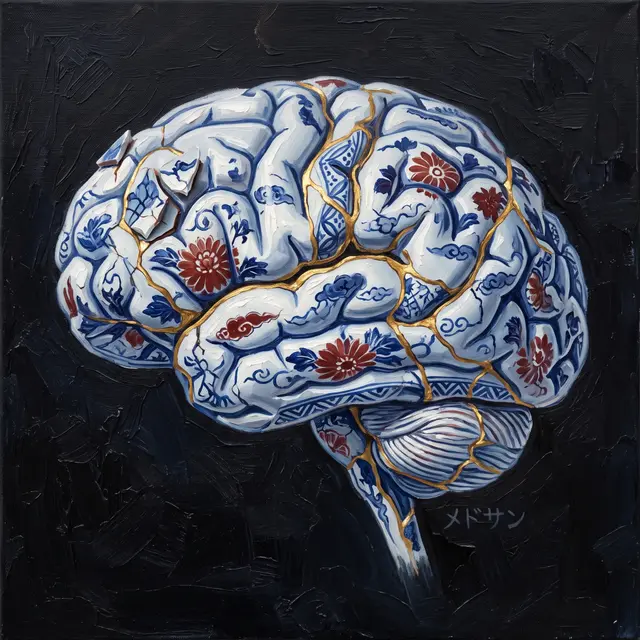
A brain in profile, in white porcelain painted with blue and red flowers. It is cracked all over, and every crack has been mended with gold. It is the painting of a man who learned to speak again after a stroke.
Shipping to Europe €45 · usually 2 to 3 weeks, no later than 28 days after payment
For Christmas in the UK: order by Thursday 26 November, delivered by 24 December at the latest.
Fine art print on canvas, 3.8 cm (1.5 in) wooden stretcher, signed and numbered by hand
Card payment via Stripe; shipping cost and delivery countries shown at checkout, before you pay
14 days to change your mind after delivery (return shipping at your expense, refund within 14 days of receiving the return)
2-year legal guarantee of conformity
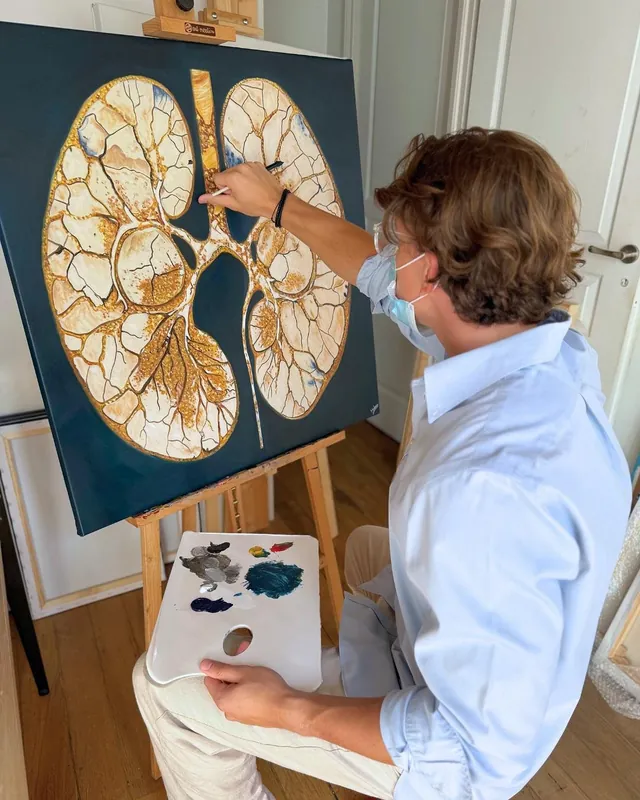
William San
William San paints the Medsan canvases in Orléans, France, at the Atelier Joconde, his family's studio.
He signs and numbers every print by hand: 20 per size, never more.
Read the Medsan Story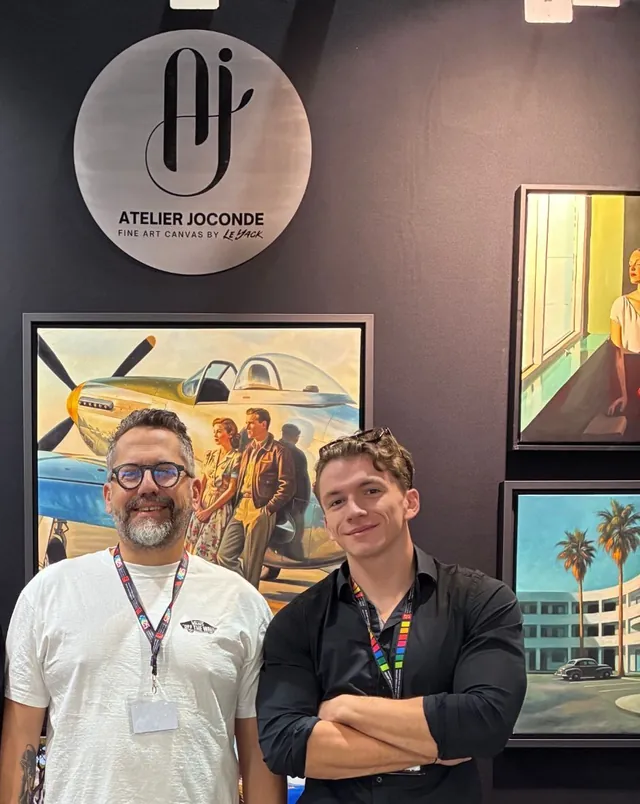
On a midnight blue ground, close to black, a brain seen from the side, with its cerebellum and the start of the spinal cord. Every fold is there, but the material is porcelain: a milky white covered in cobalt scrolls, clouds and brick-red chrysanthemums. Gold lines follow the grooves and cut across them. Toward the front of the brain, two shards have lifted, as if they had just been put back. Bottom right, the signature in katakana: メドサン, Medsan.
An Imari bowl, broken and mended with gold: William San only had to look at its cracks to see a brain.
The man behind the painting is fifty-six. One morning at breakfast, his cup slides out of his right hand and his words get tangled. A stroke: his wife calls 911 and he is treated within the hour. Six months later he says his wife's name again. He ties his own shoelaces too. Neurologists call it plasticity: the brain builds new routes around the damaged area.
In Japan, broken ceramics are repaired with lacquer dusted with gold: kintsugi. The crack isn't hidden. It becomes the pattern. On the canvas, each gold line is a path that speech found again.
In 2006 the neurologist Jeffrey Saver estimated what each minute of an untreated large ischemic stroke costs, on average. 1.9 million neurons, 14 billion synapses and 7.5 miles (12 km) of nerve fiber lost per minute. Compared with normal aging, the brain deprived of blood ages 3.6 years every hour. The emergency slogan time is brain dates from 1993 (Camilo Gomez); Saver put numbers on it.
How much rehabilitation can win back depends on how much was saved in the first hours.
Source: Saver J. L., "Time is brain, quantified", Stroke, vol. 37, no. 1, 2006, pp. 263-266 (PubMed 16339467).
The gift usually comes from a family, once the patient is home. More often than not it thanks a whole team: the emergency doctor, the neurologist, the speech therapist, the physical therapist.
The painting is about repair: you see the gold first. William San painted it from the story of someone getting better.
Yes, since it tells of speech coming back. Hokusai's Jaw, a jaw caught in the waves, is also about speech lost after a stroke.
The shape, the lobes, the cerebellum and the brainstem are where they belong. The porcelain decoration follows the cracks, not the map of the cortex.
facial palsy
Black Friday price€150Regular price€300
a face in profile turning into an anatomical study, camellias; facial palsy.
Black Friday price€150Regular price€300
a cherry-tree brain losing its petals; Alzheimer's disease.
Black Friday price€150Regular price€300
a glass skull holding a calm pool; anxiety soothed.
Black Friday price€150Regular price€300
a head in pieces being put back together; rebuilding after trauma.
Black Friday price€150Regular price€300
Shipping to Europe €45 · usually 2 to 3 weeks, no later than 28 days after payment
For Christmas in the UK: order by Thursday 26 November, delivered by 24 December at the latest.
A brain in profile, in white porcelain painted with blue and red flowers. It is cracked all over, and every crack has been mended with gold. It is the painting of a man who learned to speak again after a stroke.
Shipping to Europe €45 · usually 2 to 3 weeks, no later than 28 days after payment
For Christmas in the UK: order by Thursday 26 November, delivered by 24 December at the latest.
Fine art print on canvas, 3.8 cm (1.5 in) wooden stretcher, signed and numbered by hand
Card payment via Stripe; shipping cost and delivery countries shown at checkout, before you pay
14 days to change your mind after delivery (return shipping at your expense, refund within 14 days of receiving the return)
2-year legal guarantee of conformity
William San
William San paints the Medsan canvases in Orléans, France, at the Atelier Joconde, his family's studio.
He signs and numbers every print by hand: 20 per size, never more.
Read the Medsan StoryOn a midnight blue ground, close to black, a brain seen from the side, with its cerebellum and the start of the spinal cord. Every fold is there, but the material is porcelain: a milky white covered in cobalt scrolls, clouds and brick-red chrysanthemums. Gold lines follow the grooves and cut across them. Toward the front of the brain, two shards have lifted, as if they had just been put back. Bottom right, the signature in katakana: メドサン, Medsan.
An Imari bowl, broken and mended with gold: William San only had to look at its cracks to see a brain.
The man behind the painting is fifty-six. One morning at breakfast, his cup slides out of his right hand and his words get tangled. A stroke: his wife calls 911 and he is treated within the hour. Six months later he says his wife's name again. He ties his own shoelaces too. Neurologists call it plasticity: the brain builds new routes around the damaged area.
In Japan, broken ceramics are repaired with lacquer dusted with gold: kintsugi. The crack isn't hidden. It becomes the pattern. On the canvas, each gold line is a path that speech found again.
In 2006 the neurologist Jeffrey Saver estimated what each minute of an untreated large ischemic stroke costs, on average. 1.9 million neurons, 14 billion synapses and 7.5 miles (12 km) of nerve fiber lost per minute. Compared with normal aging, the brain deprived of blood ages 3.6 years every hour. The emergency slogan time is brain dates from 1993 (Camilo Gomez); Saver put numbers on it.
How much rehabilitation can win back depends on how much was saved in the first hours.
Source: Saver J. L., "Time is brain, quantified", Stroke, vol. 37, no. 1, 2006, pp. 263-266 (PubMed 16339467).
The gift usually comes from a family, once the patient is home. More often than not it thanks a whole team: the emergency doctor, the neurologist, the speech therapist, the physical therapist.
The painting is about repair: you see the gold first. William San painted it from the story of someone getting better.
Yes, since it tells of speech coming back. Hokusai's Jaw, a jaw caught in the waves, is also about speech lost after a stroke.
The shape, the lobes, the cerebellum and the brainstem are where they belong. The porcelain decoration follows the cracks, not the map of the cortex.
facial palsy
Black Friday price€150Regular price€300
a face in profile turning into an anatomical study, camellias; facial palsy.
Black Friday price€150Regular price€300
a cherry-tree brain losing its petals; Alzheimer's disease.
Black Friday price€150Regular price€300
a glass skull holding a calm pool; anxiety soothed.
Black Friday price€150Regular price€300
a head in pieces being put back together; rebuilding after trauma.
Black Friday price€150Regular price€300
Shipping to Europe €45 · usually 2 to 3 weeks, no later than 28 days after payment
For Christmas in the UK: order by Thursday 26 November, delivered by 24 December at the latest.