Carpe Diem
Black Friday price€150Regular price€300
two koi around an X-ray of the lower back.

A bonsai whose trunk is a spine curving in an S. A canvas about scoliosis, and about the idea that you guide a curve more than you straighten it.
Shipping to Europe €45 · usually 2 to 3 weeks, no later than 28 days after payment
For Christmas in the UK: order by Thursday 26 November, delivered by 24 December at the latest.
Fine art print on canvas, 3.8 cm (1.5 in) wooden stretcher, signed and numbered by hand
Card payment via Stripe; shipping cost and delivery countries shown at checkout, before you pay
14 days to change your mind after delivery (return shipping at your expense, refund within 14 days of receiving the return)
2-year legal guarantee of conformity
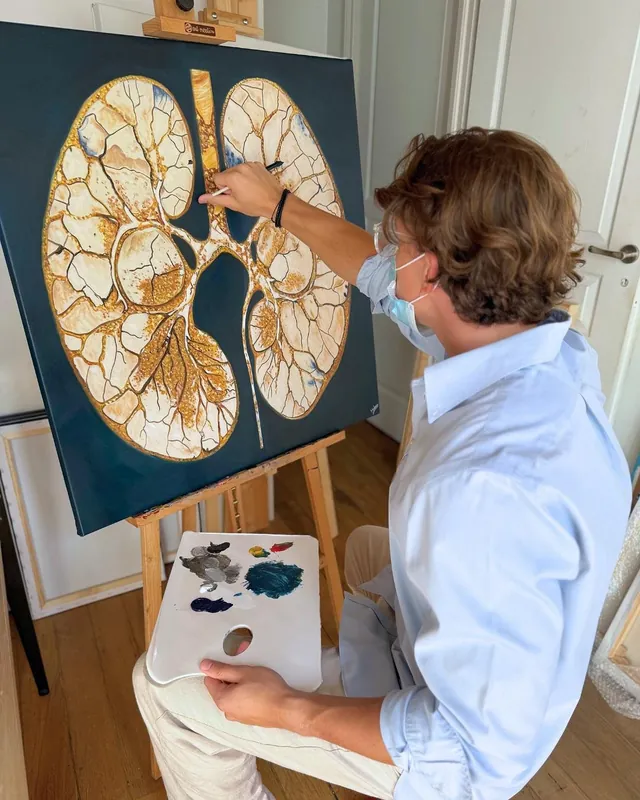
William San
William San paints the Medsan canvases in Orléans, France, at the Atelier Joconde, his family's studio.
He signs and numbers every print by hand: 20 per size, never more.
Read the Medsan Story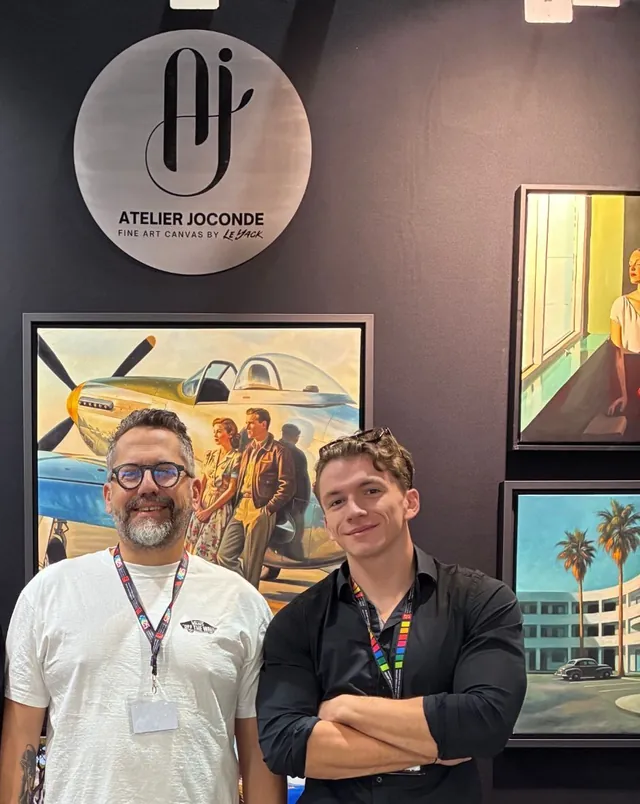
A small tree in a rough wooden tray, by a paned window letting in pale daylight. Its trunk is made of dark green vertebrae stacked one on another. They lean left, come back right, lean again, then open into pine branches. The room is quiet, almost grey; all the green is in the tree.
It began with a sentence William San overheard in a treatment room: "you can shape a spine, you never quite straighten it". The bonsai came right after.
The canvas tells of a thirteen-year-old girl who learns she has scoliosis at a school check-up. She is fitted with a brace and told she will grow up with her curve. For a long time she refuses to look at her own back in a mirror.
The trunk rises in an S, like the moyogi or "informal upright" style of bonsai, where the curves are guided over years with wire and pruning, never forced in one go.
Scoliosis means a sideways curve of at least 10 degrees on a front-view X-ray (the Cobb angle), with the spine twisting on itself. The idiopathic form, with no known cause, affects 1 to 3% of children aged 10 to 16. Boys and girls are affected equally often, but in girls the curve is about ten times more likely to worsen to the point of needing treatment.
That is why the girl in the story wears a brace: at thirteen, the aim is to stop the curve progressing while she grows, not to erase it.
Whether bracing works was settled in 2013. The BrAIST trial was stopped early: 72% of braced teenagers avoided a curve severe enough for surgery, against 48% with observation alone, and the more hours a day the brace was worn, the better it worked. Like bonsai wire, it only works if it stays on.
Sources: Weinstein S. L. et al., "Effects of bracing in adolescents with idiopathic scoliosis", New England Journal of Medicine, vol. 369, 2013, pp. 1512-1521; MSD Manual Professional Version, "Idiopathic Scoliosis"; Haute Autorité de santé (France), long-term condition guide no. 26, "Scoliose idiopathique structurale évolutive".
You look after a bonsai the way you look after a back: a little at a time, for years. Scoliosis is managed by a specialist; the osteopath is the one who helps you live with your back between appointments.
Yes. One person places the order; the card can carry everyone's names.
That's exactly who it was painted for.
It will not be reprinted. After the twentieth copy, that size leaves the site; the other one stays on sale until its own twentieth.
Black Friday price€150Regular price€300
two koi around an X-ray of the lower back.
Black Friday price€150Regular price€300
a woman in a purple kimono facing her own skeleton; osteoporosis.
Black Friday price€250Regular price€400
a woman in a blue kimono, her back opened on the spine; vertical 40 × 60.
Black Friday price€150Regular price€300
Shipping to Europe €45 · usually 2 to 3 weeks, no later than 28 days after payment
For Christmas in the UK: order by Thursday 26 November, delivered by 24 December at the latest.
A bonsai whose trunk is a spine curving in an S. A canvas about scoliosis, and about the idea that you guide a curve more than you straighten it.
Shipping to Europe €45 · usually 2 to 3 weeks, no later than 28 days after payment
For Christmas in the UK: order by Thursday 26 November, delivered by 24 December at the latest.
Fine art print on canvas, 3.8 cm (1.5 in) wooden stretcher, signed and numbered by hand
Card payment via Stripe; shipping cost and delivery countries shown at checkout, before you pay
14 days to change your mind after delivery (return shipping at your expense, refund within 14 days of receiving the return)
2-year legal guarantee of conformity
William San
William San paints the Medsan canvases in Orléans, France, at the Atelier Joconde, his family's studio.
He signs and numbers every print by hand: 20 per size, never more.
Read the Medsan StoryA small tree in a rough wooden tray, by a paned window letting in pale daylight. Its trunk is made of dark green vertebrae stacked one on another. They lean left, come back right, lean again, then open into pine branches. The room is quiet, almost grey; all the green is in the tree.
It began with a sentence William San overheard in a treatment room: "you can shape a spine, you never quite straighten it". The bonsai came right after.
The canvas tells of a thirteen-year-old girl who learns she has scoliosis at a school check-up. She is fitted with a brace and told she will grow up with her curve. For a long time she refuses to look at her own back in a mirror.
The trunk rises in an S, like the moyogi or "informal upright" style of bonsai, where the curves are guided over years with wire and pruning, never forced in one go.
Scoliosis means a sideways curve of at least 10 degrees on a front-view X-ray (the Cobb angle), with the spine twisting on itself. The idiopathic form, with no known cause, affects 1 to 3% of children aged 10 to 16. Boys and girls are affected equally often, but in girls the curve is about ten times more likely to worsen to the point of needing treatment.
That is why the girl in the story wears a brace: at thirteen, the aim is to stop the curve progressing while she grows, not to erase it.
Whether bracing works was settled in 2013. The BrAIST trial was stopped early: 72% of braced teenagers avoided a curve severe enough for surgery, against 48% with observation alone, and the more hours a day the brace was worn, the better it worked. Like bonsai wire, it only works if it stays on.
Sources: Weinstein S. L. et al., "Effects of bracing in adolescents with idiopathic scoliosis", New England Journal of Medicine, vol. 369, 2013, pp. 1512-1521; MSD Manual Professional Version, "Idiopathic Scoliosis"; Haute Autorité de santé (France), long-term condition guide no. 26, "Scoliose idiopathique structurale évolutive".
You look after a bonsai the way you look after a back: a little at a time, for years. Scoliosis is managed by a specialist; the osteopath is the one who helps you live with your back between appointments.
Yes. One person places the order; the card can carry everyone's names.
That's exactly who it was painted for.
It will not be reprinted. After the twentieth copy, that size leaves the site; the other one stays on sale until its own twentieth.
Black Friday price€150Regular price€300
two koi around an X-ray of the lower back.
Black Friday price€150Regular price€300
a woman in a purple kimono facing her own skeleton; osteoporosis.
Black Friday price€250Regular price€400
a woman in a blue kimono, her back opened on the spine; vertical 40 × 60.
Black Friday price€150Regular price€300
Shipping to Europe €45 · usually 2 to 3 weeks, no later than 28 days after payment
For Christmas in the UK: order by Thursday 26 November, delivered by 24 December at the latest.